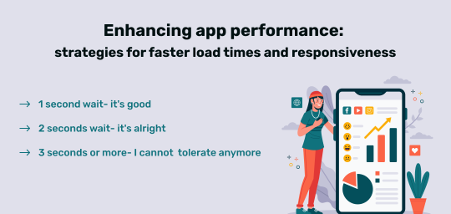
Best user experience, high user satisfaction, increased user retention, and improved user engagement lie at the intersection point of the app’s performance. It’s entirely true because user waits only for 2-3 seconds for the app loading and if it takes longer, they instantly close or uninstall the app.
Not only users but app stores also take app performance seriously. They keep app performance as a priority and expect the app to be responsive with minimal resource consumption—also, apps with frequent crashes or bugs are not accepted by the app stores.
What does it signal?
It’s an indication that everyone is treating performance as an important consideration, and businesses should be serious about the same. Poor app performance creates a disaster for businesses that leading to huge losses.
Negative consequences that businesses bear from poor app performance
- – Loading delays take the users to competition, leading to a drop in conversion.
- – User retention becomes difficult, and lifetime value gets reduced as well
- – Increases the number of tickets for the support team and the workload of developers improves, which amplifies the operational cost.
- – Organic app installs go southward, which lowers app store ranking.
- – The app uninstallation rate gets intensified.
- – Unresponsiveness frustrates users, which results in a decline in revenue.
It underlines the importance of the app’s performance, which is essential for business growth, user satisfaction, and competitive advantage. Using various tools such as Firebase Performance, New Relic, and Datadog, businesses can monitor the app performance and fix the issues ahead of the app launch. It translates to a better reputation, improved revenue, and a lot more benefits in the hyper-competitive landscape. Take a look at the top 7 strategies that help businesses avoid irreversible brand damage with slow loading.
7 pro tips to improve the app’s performance like no other
Speed is a key in the age of instant gratification, and the app is no exception. Considering the few strategies will help you enhance the app’s performance.
– Eliminate inefficiencies with optimized coding practices.
The selection of the right programming languages, tools, and other resources doesn’t ensure flawless app development. Instead, efficient coding practices make the app load at speed. When clean and concise code is not written, then code optimization, unnecessary or redundant code removal, outdated algorithms, or framework elimination will help improve the app’s performance. Continuously reviewing and reworking code improves overall app speed, minimizes resource consumption, and lower processing overheads.
– Minimize the app’s size for better app performance
The comprehensive apps with advanced features and high-end designs often perform slowly on low-end devices or with low internet connection. Removing unnecessary features and keeping only required features that get things done allows businesses to reduce the app’s size, take the performance up a notch, and increase the number of conversions.
– Compressing multimedia content is a game-changer
Adding images and videos will improve user engagement as visual content is easy to consume as compared to text. However, adding a large number of images will increase the app’s size and delay the loading. When the multimedia content is compressed without losing image quality, the app’s loading speed is improved. Using the right image format during compression lends a hand in enhancing app performance.
– Ensure HTTP requests are minimal.
Despite image size compression, when the app elements load, such as script, image, etc., the HTTPS requests are sent to the server. When the number of requests increases, the app loading time gets negatively impacted. The best way to reduce HTTP requests is to bundle the image files together or leverage asynchronous loading that enables the app to perform at scale, even during peak traffic conditions.
– Memory usage management
Sometimes, the app crashes or freezes due to excessive memory usage. With continuous memory consumption monitoring, it’s easier to optimize memory allocation for different components. Additionally, the object’s re-usage in place of creating new ones leads to less memory consumption. Efficient garbage collection and reducing background tasks ensure effective memory management that lowers performance-related issues.
– Efficient data caching
When network queries get reduced, it automatically improves the app’s performance, which is possible with caching mechanism implementation. Various caching techniques facilitate storing frequently accessed data on local devices that minimize the need for sending several queries over the network. With content delivery networks, the content is distributed across multiple servers at various locations, and when served to the user from the nearest server, the content is served rapidly.
– Lazy loading implementation
The app has various pages, and loading all the elements of the pages at once impacts the app’s performance. With lazy loading implementation, the content of the app loads only when users open the page and scroll down. This approach loads all the text content at once and defers loading images or videos, which improves loading speed.
Ready to take a plunge with high performance?
In the dynamic landscape, performance concerns can bin your app in no time. Performance optimization is imperative to build a positive image, enhance user satisfaction, and seize an extra edge. Consider the seven strategic tactics that help businesses make their app high-performance-optimized and responsive everywhere. The meticulous approach ensures the app continuously performs and delivers results to the notch.